
You just landed in a new city, bags barely unpacked, and you're already hungry. The last thing you want is to waste a meal on a mediocre tourist trap with a flashy sign and a forgettable menu. The challenge is real: there are hundreds of options on every app, each one claiming to be the best. This guide cuts through the noise and gives you a practical, step-by-step approach to finding restaurants that are genuinely worth your time and money, whether you're chasing a once-in-a-lifetime tasting menu or just a killer bowl of ramen on a Tuesday night.
Table of Contents
- Know your goals and preferences
- Understand the main sources: experts vs. crowds
- How professional critics pick and rank top restaurants
- Using crowd wisdom: how to mine online reviews reliably
- Cross-check and verify: putting your shortlist to the test
- Find your next top restaurant easily with Luveats
- Frequently asked questions
Key Takeaways
| Point | Details |
|---|---|
| Clarify your preferences | Know what type of meal you want before searching so recommendations truly fit your aims. |
| Balance expert and crowd sources | Blend professional rankings with recent user reviews for the most reliable results. |
| Verify before booking | Cross-check menus, photos, and social updates to dodge disappointment and last-minute surprises. |
| Trust your fit | No list or app knows your taste better than you—always choose what matches your vibe and cravings. |
Know your goals and preferences
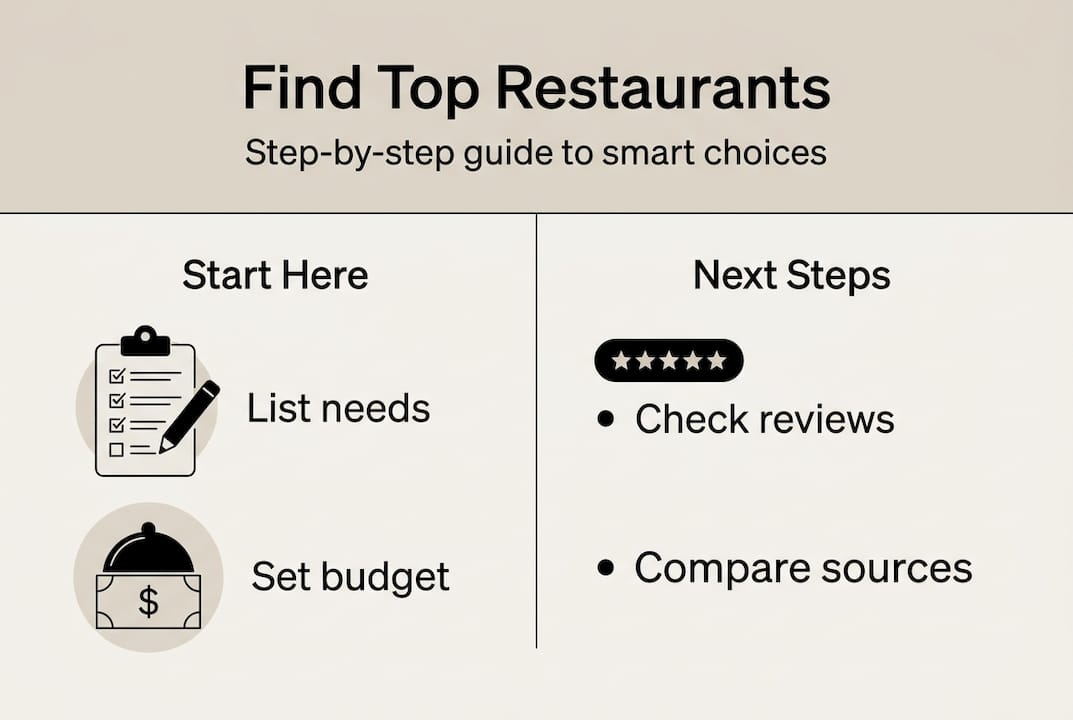
Before you open a single app or read one review, take sixty seconds to get clear on what you actually want. This sounds obvious, but most dining disappointments happen because people skip this step entirely. A restaurant that earns five stars for a romantic anniversary dinner is probably the wrong call for a loud group of eight friends celebrating a birthday.
Think about the occasion first. Are you celebrating something special, grabbing a quick solo lunch, hunting for a neighborhood gem that locals actually love, or ticking off a bucket-list icon you've read about for years? Each goal points you toward a completely different type of search. Once you know the occasion, layer in your non-negotiables.
Here are the key filtering questions to ask yourself before you search:
- What cuisine or flavor profile am I craving?
- What's my realistic budget per person, including drinks and tip?
- What's the vibe I need: lively and loud, quiet and intimate, or somewhere in between?
- How large is my group, and does anyone have dietary restrictions?
- Do I need accessibility features, a kids' menu, or outdoor seating?
- How far am I willing to travel, and do I need easy parking or transit access?
- Am I open to a wait, or do I need a reservation?
Answering these questions takes two minutes and saves you from a frustrating evening. Write them down or keep them in your notes app. Your shortlist will be sharper and your final pick will feel right before you even walk through the door.
Understand the main sources: experts vs. crowds
Now that you know what you want, the next question is where to look. Not all recommendation sources are built the same, and using the wrong one for your situation is a common mistake.

On one side, you have expert-curated lists: Michelin, the World's 50 Best Restaurants (voted by a 1,080-member academy of experts), Eater, and local outlets like the San Francisco Chronicle. These sources invest serious resources into their evaluations. On the other side, you have crowd-sourced platforms like Yelp and Google Reviews, which offer massive volume but suffer from biases and inconsistencies that can mislead casual searchers.
Here's a quick comparison to help you choose the right source for your situation:
| Source | Who rates | Best for | Watch out for |
|---|---|---|---|
| Michelin Guide | Anonymous professional inspectors | Fine dining, special occasions | Limited coverage of casual spots |
| World's 50 Best | 1,080-member expert academy | Global bucket-list dining | Skews toward high-end and trendy |
| Eater / Chronicle | Staff critics and editors | City-specific, diverse picks | Can lag behind new openings |
| Google Reviews | General public | Everyday spots, quick checks | Fake reviews, tourist bias |
| Yelp | General public | Casual dining, local gems | Inconsistent moderation |
For browsing curated picks in specific neighborhoods, city guides like Santa Monica restaurant guides or lists focused on cheap eats in LA give you a filtered starting point that blends editorial judgment with real-world relevance.
Pro Tip: Use expert lists when you're planning a special meal and want a near-guaranteed quality experience. Switch to crowd-sourced reviews when you're looking for a casual neighborhood spot or want to know what locals actually order.
How professional critics pick and rank top restaurants
Understanding how critics work helps you read their lists with more confidence. It also helps you spot when a list is genuinely rigorous versus when it's just a sponsored roundup dressed up as editorial content.
Local critics at outlets like the NYT, Eater, and the Houston Chronicle compile their best-of lists through anonymous visits, evaluating food quality, service consistency, value, and the diversity of the overall dining scene. Here's how that process typically unfolds:
- Initial scouting: Critics identify candidates through tips, reader submissions, and their own research.
- Anonymous visits: Critics dine without revealing their identity, often visiting multiple times before forming a judgment.
- Multi-criteria scoring: Food, service, ambiance, value, and menu variety are all weighed, not just the headline dish.
- Peer review: Many outlets have editorial teams that debate and challenge individual picks before publishing.
- Recency check: Lists are updated regularly to reflect closures, chef changes, and quality shifts.
"The best restaurant lists aren't snapshots. They're living documents that reflect repeated visits, honest debate, and a commitment to recency over reputation."
This is why a Michelin star from five years ago means less than a fresh mention in a current critic's column. When you're browsing NYC hidden gem reviews or checking out Chicago top 20 restaurants, look for the publication date. A list updated within the last six months is far more reliable than one that's been sitting untouched for two years. The same logic applies to any LA pizza guide or cuisine-specific roundup you find.
Using crowd wisdom: how to mine online reviews reliably
Crowd-sourced reviews are powerful when used correctly. The problem is that most people read them passively, scrolling through star ratings without applying any critical filter. That's how you end up at a restaurant with 4.7 stars that turns out to be deeply average.
Cross-checking photos and ignoring extreme ratings is one of the most effective ways to cut through the noise. Here's a practical checklist for reading online reviews like a pro:
- Ignore reviews older than 12 months. Restaurants change fast. A chef departure or ownership switch can flip quality overnight.
- Skip the one-star and five-star extremes. Focus on three and four-star reviews, where people tend to be most honest and specific.
- Compare user photos to the official menu photos. If the real dishes look nothing like the marketing shots, that's a red flag.
- Check for local vs. tourist bias. A restaurant near a major landmark will attract very different reviewers than a neighborhood spot three blocks away.
- Look for repeated mentions of the same dish. If ten different reviewers all rave about the same item, that's a reliable signal.
- Watch for generic language. Phrases like "great atmosphere" and "friendly staff" with no specifics often indicate a fake or incentivized review.
Pro Tip: When you're traveling internationally or in a city with a strong local food culture, skim reviews written by users with local profile locations. They tend to be more honest and less influenced by novelty.
For city-specific crowd wisdom, browsing curated picks like NYC dining picks or West Hollywood must-eats gives you a filtered baseline before you dive into raw review platforms. If you're planning a special evening, checking Las Vegas romantic dining options through a curated guide saves you from sifting through thousands of unfiltered reviews.
Cross-check and verify: putting your shortlist to the test
You've done your research and you have two or three strong candidates. Now comes the final step: verification. This is where most people stop short, and it's exactly where avoidable disappointments happen.
No single source is perfect, which is why prioritizing recency, multiple data points, and personal fit is the smartest final move. Here's a simple verification table to run through before you commit:
| Verification method | What to check | Why it matters |
|---|---|---|
| Restaurant website | Current menu, hours, reservation policy | Menus and hours change frequently |
| Google Maps photos | Recent user-uploaded food photos | Shows real current dishes, not PR shots |
| Instagram or TikTok | Tagged posts from the last 30 days | Reveals current vibe and food quality |
| Word of mouth | Ask a local, hotel concierge, or rideshare driver | Locals know things no app will tell you |
| Walk or drive by | Check the line, the crowd, the energy | Real-time quality signal you can't fake |
After running through this table, trust your gut on personal fit. A restaurant can check every box on paper and still feel wrong for your specific night. Maybe the vibe is too formal, or the menu shifted away from what drew you in. That's fine. The goal is a meal you'll actually remember, not one that looks good on a checklist.
For budget-conscious travelers, verifying options like Vegas value eats or a specific Vegas steakhouse guide through multiple sources before booking saves both money and disappointment.
Find your next top restaurant easily with Luveats
You now have a solid framework for finding restaurants that actually deliver. The next step is putting it into practice with a reliable starting point.
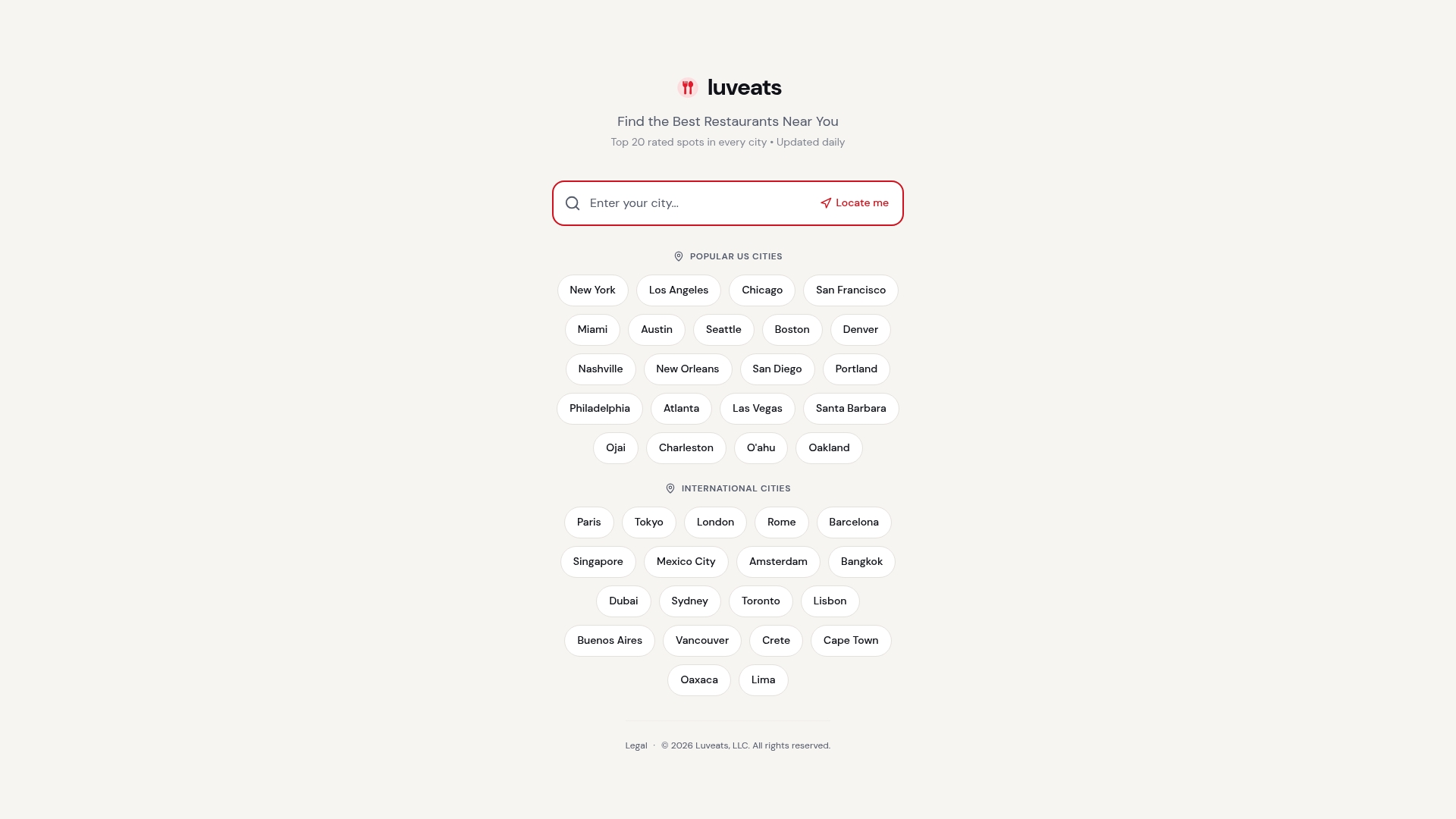
Luveats makes that first step effortless. The platform curates the top 20 restaurants in cities across the U.S. and beyond, updated daily so you're always working with current information. Whether you're looking for top restaurants in Los Angeles, want to explore NYC's secret dining spots, or need a quick look at the top 20 Chicago restaurants, Luveats gives you a filtered, trustworthy list without the noise. Browse by city, cuisine type, or occasion and skip straight to the restaurants worth your time.
Frequently asked questions
How do I avoid tourist traps when picking restaurants in a new city?
Look for places with consistent reviews from locals, recent food photos, and avoid spots with mostly generic tourist praise. Crowd-sourced reviews can show bias, so cross-check for consistency and local feedback before committing.
Are Michelin-starred restaurants always the best option?
Michelin stars often signal excellence, but many great casual or local eateries excel on crowd-sourced and local critic lists. Michelin and Yelp sometimes diverge, especially on casual spots, so match the source to the type of meal you want.
What's the best way to spot fake online restaurant reviews?
Watch for reviews with odd language, repeated phrases, and no specific dish mentions. Fake and biased reviews are common, so prioritize reviews with vivid details, recent dates, and real food photos.
How do professional critics decide what makes a restaurant 'top'?
They evaluate multiple criteria including food, service, value, and ambiance over repeated anonymous visits. Critics use anonymous visits and focus on multiple quality factors rather than a single standout dish or moment.