
More than 9 in 10 diners read reviews before deciding where to eat, yet most have no idea how those star ratings are actually built. Behind every score is a mix of algorithms, filters, and ranking signals that can quietly distort what you see. Understanding how these systems work gives you a real edge, whether you're hunting for a neighborhood gem or planning a meal in an unfamiliar city. This article breaks down the mechanics, compares the biggest platforms, exposes common traps, and gives you a smarter playbook for using reviews to your advantage.
Table of Contents
- What is a restaurant review system?
- How different platforms rate and rank restaurants
- How algorithms and filters shape what diners see
- Common pitfalls and biases in review systems
- Expert strategies: how to use restaurant reviews like a pro
- Discover curated restaurant picks near you
- Frequently asked questions
Key Takeaways
| Point | Details |
|---|---|
| Not all ratings are equal | Different platforms use distinct algorithms and filters, so star averages alone can be misleading. |
| Watch for hidden biases | Review filters and selection bias can hide or distort legitimate diner opinions. |
| Cross-check for accuracy | Comparing platforms and focusing on recent, detailed reviews leads to smarter choices. |
| Review volume matters | Steady, high-volume feedback is more trustworthy than sporadic bursts. |
| Curated guides save time | Expert-vetted lists help diners cut through noise and discover truly reliable spots. |
What is a restaurant review system?
A restaurant review system is a platform feature that collects user-submitted star ratings and written feedback, then processes that data into an overall score. That score is what most diners see first, and it heavily shapes their decision. Major platforms aggregate user ratings and reviews to compute scores that influence where people eat and how much they spend.
The three platforms that dominate this space are:
- Yelp — community-driven, with a proprietary filter that screens which reviews count toward the score
- Google — integrated with Maps and Search, pulling from a massive user base
- TripAdvisor — travel-focused, weighting recency and volume heavily in its rankings
These systems matter because 94% of diners say online reviews influence where they choose to eat. That's not a small nudge. It means a restaurant's rating can make or break its foot traffic on any given night. For diners, trusting a flawed score without understanding how it was built can lead to disappointing meals and missed opportunities.
Review systems are powerful tools, but they're only as reliable as the data and logic behind them. That's exactly why it pays to look deeper.
How different platforms rate and rank restaurants
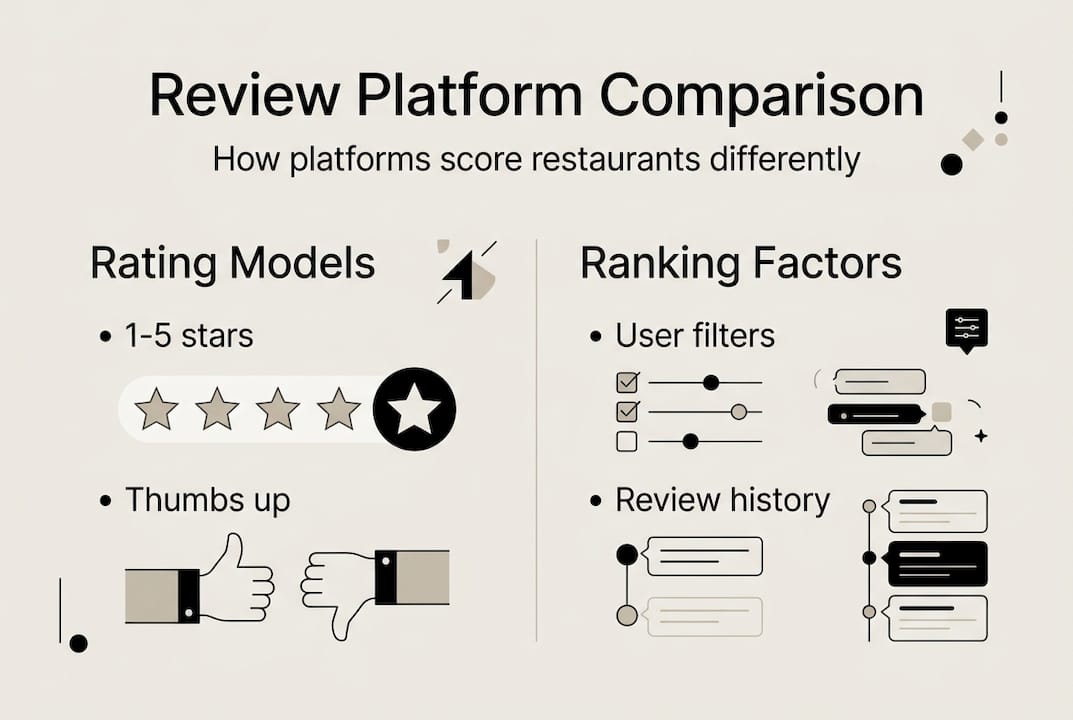
Not all review platforms use the same formula, and those differences can produce noticeably different scores for the exact same restaurant. Google ranks restaurants by relevance, proximity, and prominence, and a single star increase can translate directly into a measurable revenue boost for a business.

Yelp takes a different approach. Its proprietary filter algorithm decides which reviews are "recommended" and which are hidden. Research shows Google ratings average 0.7 stars higher than Yelp for the same restaurants, largely because Yelp's filter removes more reviews from its visible score.
Here's a side-by-side look at how the three major platforms compare:
| Platform | Rating model | Key ranking factors | Review filtering |
|---|---|---|---|
| Yelp | 1-5 stars, recommended only | Relevance, activity, filter | High (up to 25% hidden) |
| 1-5 stars, all reviews | Relevance, proximity, prominence | Low to moderate | |
| TripAdvisor | 1-5 bubbles | Recency, volume, quality | Moderate |
Because each platform weighs factors differently, you'll often see a restaurant sitting at 4.2 on Google and 3.7 on Yelp simultaneously. Neither score is wrong, but neither tells the full story alone. When you're scoping out NYC hidden gems or searching for the best LA pizza, cross-checking two or three platforms gives you a much clearer picture than relying on just one.
Pro Tip: If a restaurant scores well on both Yelp and Google despite Yelp's stricter filter, that's a strong signal of consistent quality.
How algorithms and filters shape what diners see
Knowing that platforms use different systems is one thing. Understanding what those systems actually hide from you is another level entirely.
Yelp's filter is the most aggressive of the major platforms. Yelp filters up to 25% of legitimate reviews, prioritizing input from users with established activity histories and hiding feedback from newer or infrequent reviewers. This means a first-time visitor who had a genuinely great meal might leave a glowing review that never gets counted in the score.
"All review systems struggle with fake reviews, but they improve over time by balancing authenticity vs. volume in their ranking logic."
Here's how filter behavior breaks down across user profiles:
| User profile | Yelp review status | Google review status |
|---|---|---|
| Active, long-term user | Usually recommended | Usually visible |
| New or infrequent user | Often filtered out | Usually visible |
| Single-review account | Frequently hidden | Visible but flagged |
| Suspected fake account | Removed | Removed |
For diners, this creates a real blind spot. The star average you see on Yelp may be based on only 75% of submitted reviews. If a restaurant recently opened and attracted a wave of enthusiastic first-timers, many of those positive reviews could be invisible to you. The same logic applies in reverse: a flood of negative reviews from new accounts might also get filtered, protecting a restaurant from coordinated attacks.
When you're browsing options like Santa Monica restaurants, keep in mind that the visible score is a filtered snapshot, not a complete picture.
Pro Tip: On Yelp, scroll to the bottom of a restaurant's page and click "reviews that are not currently recommended" to see what's been filtered out. It's often revealing.
Common pitfalls and biases in review systems
Algorithms try to make review scores fair, but several structural biases still slip through and mislead diners regularly.
The biggest issue is selection bias. Most people who leave reviews have had either a fantastic experience or a terrible one. The diner who had a perfectly fine, average meal rarely bothers to write anything. This means review distributions tend to cluster at the extremes, and the "average" score you see doesn't always reflect the typical experience.
Other common pitfalls include:
- Award-driven rating drops — restaurants that earn a Michelin star or major press coverage often see their ratings fall afterward because expectations spike and diners become more critical
- Hidden legitimate reviews — selection bias and fake detection failures mean real opinions from real customers sometimes never reach the score
- Review bombing — coordinated waves of 1-star reviews from competitors or disgruntled groups can tank a score before platforms catch and remove them
- Recency gaps — a restaurant that was excellent two years ago but has since changed ownership or chefs may still carry a high legacy score
Exploring Chicago's dining scene or any major city means navigating all of these issues at once. A 4.5-star rating from three years ago tells you very little about tonight's dinner.
Pro Tip: Look for a steady stream of recent, moderately positive reviews rather than a burst of 5-star ratings followed by silence. Consistency is the real green flag.
Expert strategies: how to use restaurant reviews like a pro
Now that you understand the mechanics and the pitfalls, here's how to actually use review systems to make better dining decisions every time.
- Check at least two platforms. A restaurant that scores well on both Google and Yelp, despite Yelp's stricter filter, has earned its reputation twice over. Differences between platforms can also reveal hidden gems or warning signs.
- Prioritize recent reviews. Filter by "newest first" on every platform. A steady review flow over the past few months is far more reliable than a high score built on old feedback.
- Read the 3-star reviews. These tend to be the most balanced and honest. They come from diners who weren't motivated by extreme emotion, which makes them the most representative of a typical visit.
- Check review volume. A 4.8-star rating from 12 reviews means far less than a 4.3-star rating from 800 reviews. Volume adds statistical weight and reduces the impact of outliers.
- Look for owner responses. Restaurants that respond thoughtfully to both positive and negative feedback signal that management is engaged and cares about the experience. That's a quality indicator that star ratings don't capture.
- Use curated guides alongside raw ratings. Platforms like Luveats filter out the noise by combining review data with editorial curation, giving you a shortlist of genuinely reliable spots. Whether you're after affordable LA eats or want to explore the full LA pizza guide, curated lists save you the legwork of cross-referencing multiple platforms yourself.
Applying even three or four of these habits consistently will make you a significantly sharper diner, whether you're eating locally or traveling somewhere new.
Discover curated restaurant picks near you
Reading reviews critically is a skill, but it still takes time. That's where Luveats comes in. Instead of manually cross-checking Yelp, Google, and TripAdvisor for every meal, you can browse a curated, daily-updated list of the top 20 restaurants in cities across the U.S. and beyond.
Luveats goes beyond raw star averages by combining real review data with editorial curation, so every recommendation reflects current quality, not just historical reputation. Whether you're planning a night out in your own city or scoping dining options before a trip, the platform makes it easy to find spots worth your time and money. Explore LA's best restaurants, check out top New York restaurants, or find the best restaurants near you with confidence.
Frequently asked questions
Why do the same restaurants have different ratings on Yelp and Google?
Each platform uses its own algorithm and filtering rules, which is why scores for the same restaurant can differ by up to 0.7 stars on average. Yelp's stricter filter removes more reviews, pulling its scores lower than Google's.
Do filtered reviews matter if they're not shown?
Absolutely. Yelp filters up to 25% of legitimate reviews, which means the visible score can significantly underrepresent or overrepresent actual customer sentiment.
What's the best way to spot fake or biased reviews?
Look for detailed, recent feedback spread across multiple platforms, and be cautious of clusters of only extreme highs or lows. Selection bias is common across all platforms, so balanced, moderate reviews are usually the most trustworthy.
Does a restaurant's star rating affect its business?
Significantly. A higher average rating can boost revenue by 5-9% per additional star, which is why restaurants invest heavily in managing their online reputation.